July 10, 2026
Use a real estate proration calculator to split taxes accurately and close without delays.
A real estate proration calculator is a tool. It splits costs like property taxes and rent between the buyer and the seller. It does this based on how many days each person owns the house during the year.
Here is the quick answer to how it works:
| Step | What You Do |
|---|---|
| 1 | Enter the yearly property tax amount |
| 2 | Enter the closing date |
| 3 | Choose your calculation method (365-day or 360-day) |
| 4 | The calculator shows each person's share to the exact day |
Who owes what?
Closing day can be stressful. You have to sign many papers, move money, and get the keys. You do not want any bad surprises on your final bill.
But splitting property taxes is a common thing that confuses people. Many homes sell every year, and each one needs a fair tax split. Even small math mistakes can cause arguments later.
Getting the numbers right before you sign is very important.
I'm Michael J. MacFarlane. I am a real estate broker with over 30 years of experience helping people buy and sell homes in Houston. I help them with tax splits so their deals go smoothly. In this guide, I will show you how a real estate proration calculator works. This way, you can go to your closing meeting with no worries.
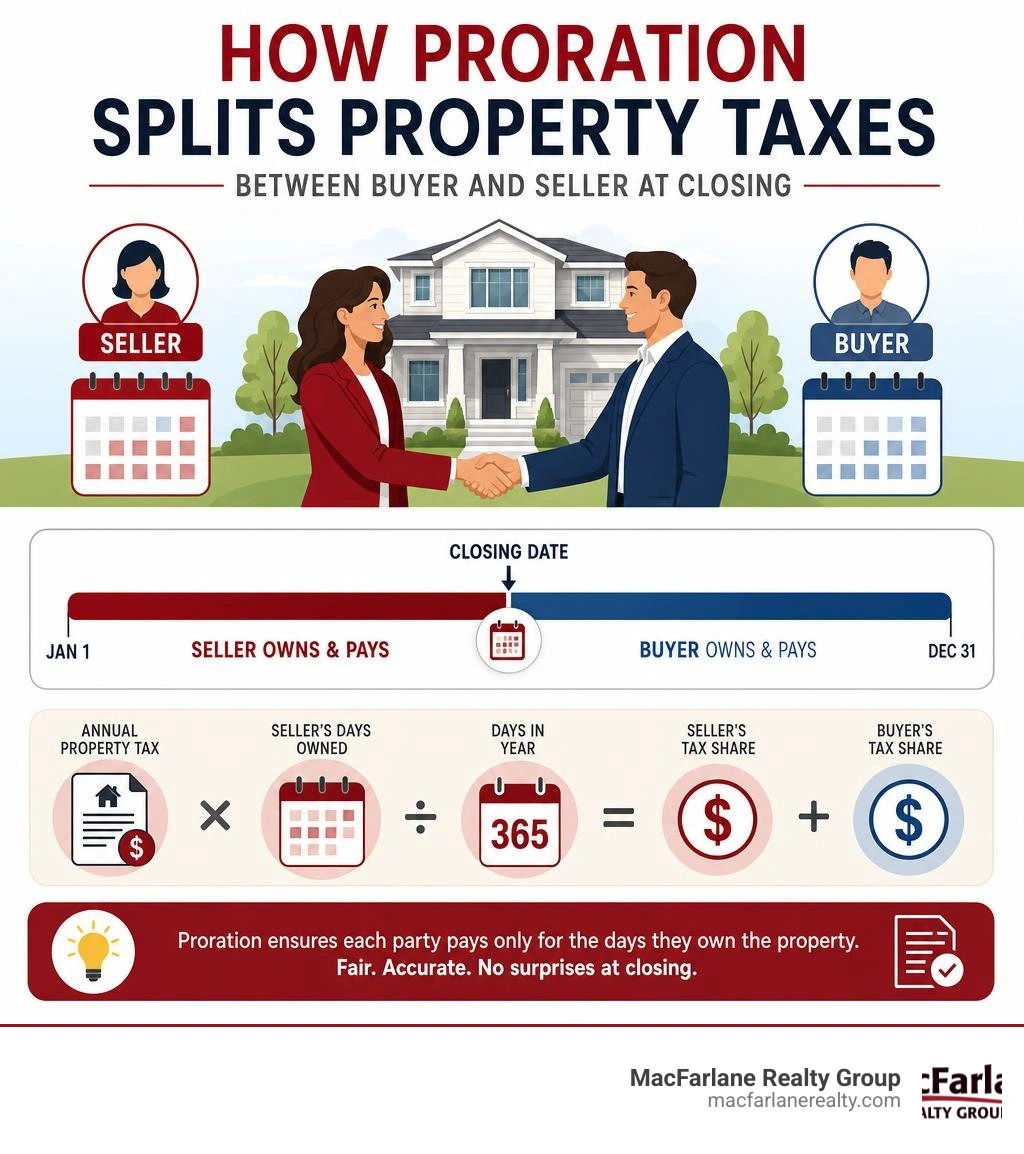
Easy real estate proration calculator glossary:

A real estate proration calculator is a simple online tool. It helps buyers, sellers, and agents split home costs fairly. Most people do not buy or sell a home on the very first day of the year. Most sales happen in the middle of a month or year.
Proration means dividing a bill based on time. The calculator takes the big yearly bill and finds the cost for just one day. Then, it counts how many days the seller lived there and how many days the buyer will live there.
To find the daily tax rate, the math is:
Daily Tax Rate = Yearly Property Tax / Days in the Year (365 or 360)
Next, the calculator multiplies that daily rate by the number of days for each person. Most real estate workers use these digital tools to make sure the math is perfect. You can try a free tool like the Tax Proration Calculator for Buyers and Sellers to see how it works.
Using a real estate proration calculator is very easy. You only need a few simple facts to start.
First, you need the yearly tax amount. You can find this on the latest tax bill or on the county website. Next, you need the exact day you close the sale. Finally, you need to know the tax year. In Texas, the tax year goes from January 1 to December 31.
Once you type in these numbers, the tool does the rest. It counts the exact days of ownership for both people. If you want to try it yourself, you can use our Real Property Tax Calculator to see your estimated split.
Why does this math matter? Because property taxes change how much cash you need on closing day.
In Texas, we pay property taxes at the end of the year. This means the bill for this year is not due until December. If you sell your house in July, you have not paid any taxes for this year yet. At the closing meeting, you must give the buyer money for the days you lived in the house. This means you take home a little less cash from the sale.
If you are the buyer, you will get this money as a credit from the seller. But when the big tax bill comes in December, you must pay the whole thing yourself.
Without a good calculator, it is easy to make a mistake. A small error can cause a fight after the sale is done. To plan your budget early, we suggest looking at Property Tax Estimates before your closing day.
Proration is not just for taxes. It is also used for rent, neighborhood fees (HOA dues), and utility bills.
The main goal is fairness. No one should pay for a service or a tax for days they did not own or live in the house.
Here is a quick look at how tax splits and rent splits compare:
| Feature | Property Tax Proration | Rent Proration |
|---|---|---|
| Billing Period | Yearly (usually the calendar year) | Monthly |
| Who Pays Whom? | Seller gives credit to buyer (usually) | Tenant pays landlord |
| Common Method | 365-day actual calendar | 30-day banker's month |
| Payment Timing | Paid at the end of the year | Paid at the start of the month |
These two calculations use the same basic ideas, but they have some differences.
Rent proration is used when a tenant moves in or out in the middle of a month. For rent, we look at the monthly rate. If rent is $1,500 and the tenant moves in on the 16th of a 30-day month, they only pay for 15 days.
Landlords can use different rules for this. Some count the exact days in that month. Others pretend every month has 30 days. If you are a landlord or tenant, you can use the Prorated rent calculator | RentSpree to check your math. You can also download the Prorate Calculator Pro App - App Store to run these numbers on your phone.
How the calculator handles money depends on whether the bills are paid early or paid late.
To see how these bills affect your total costs, you can ask for a Land Tax Estimate to see what you might owe.

Not all calculators use the same calendar rules. The method you choose can change the final numbers. Using a 365-day method instead of a 360-day method can change the final tax amount by a small percentage.
Most online tools, like the Prorate Calculator, let you choose which method you want to use.
This is the most common and exact method. It uses the real number of days in the year. That is 365 days, or 366 days in a leap year.
To find the daily rate, you divide the yearly bill by 365. Then, you count the exact days of ownership. For example, if you close on June 15, the seller owned the home for 166 days. The buyer will own it for the other 199 days. This is the standard way to do things for home sales in Texas.
The 360-day method pretends that every single month has exactly 30 days.
In this system, the year has 12 months of 30 days, which equals 360 days. This method is very popular for business properties and home loans because it makes the math simpler. But because it does not match the real calendar, the final numbers will be slightly different from the 365-day method.
Property taxes are very local. Every state and county has its own rules. For example, if you are studying to get a real estate license, you might use a Free Florida Real Estate Exam Proration Calculator. If you live in the Midwest, you might look at an Iowa Tax Proration Calculator.
But here in the Houston area, we must follow Texas laws and county rules.
In Texas, we do not have a state income tax. Instead, local areas rely on property taxes to pay for schools, roads, and police.
Because of this, tax rates can be very different from one neighborhood to the next. Your tax bill is made of several parts. You will pay taxes to the county, the city, the school district, and sometimes a water district (MUD).
Each county has its own office to value homes. If you are buying a home in Brazoria County, you should check the Tax Estimator - Brazoria County Tax Office. If you are in Chambers County, you can read the Property Tax System Guide | Chambers County, TX. For homes in Austin County, you will want to check the Austin County Appraisal District website.
Online tools are great for getting a quick guess. You can use tools like the Prorated Taxes Calculator - Calculate Property Tax Proration(2026) | The Money Pocket or the Prorate Calculator - Baird Law to get a close estimate of your costs.
But you should never rely on online tools for the final, official numbers.
Your title company will calculate the official numbers for your final papers. They will check for tax discounts, like the homestead exemption, which can make the bill lower. They will also look for any unpaid taxes that the seller must pay before you can own the home.
If you think your home's tax value is too high, you can try to lower it. Check out our guide on how to Reduce Property Taxes Houston to learn how to protest your taxes.
In most Texas home sales, the buyer owns the home on the closing day. This means the seller pays taxes up to the day before closing. The buyer pays taxes starting on the closing day and going forward. But you can negotiate this in your contract, so always check your agreement.
This happens a lot in Texas. Tax bills come out in October, but many homes sell earlier in the year. If the county raises the taxes after you buy the home, your real bill will be higher than the guess used at closing.
To fix this, most contracts have a tax agreement. This says that the buyer and seller will recalculate the split and pay each other back once the real bill arrives.
Special assessments are extra taxes for local updates, like new streetlights. Because these updates help the home for a long time, they are handled differently than regular taxes. The contract should say if the seller must pay the whole bill at closing or if the buyer will take over the payments.
At MacFarlane Realty Group, we want your closing day to be happy, not stressful. For over 25 years, we have helped buyers and sellers across Houston and Harris County.
Learning how a real estate proration calculator works is just one way to protect your money. Whether you are buying your very first home or a big business property, we are here to help you every step of the way with clear and friendly advice.
Let us help you make your next move with confidence. If you need help with property taxes or closing prep, Get professional tax services with us today. Tell us what you need, and we will handle the rest.

Ask a question, request a home valuation, or get an honest read on the current market. We are here when you are ready.