July 8, 2026
Master your Texas BPP filing guide with our step-by-step survival guide for commercial property tax compliance and savings.
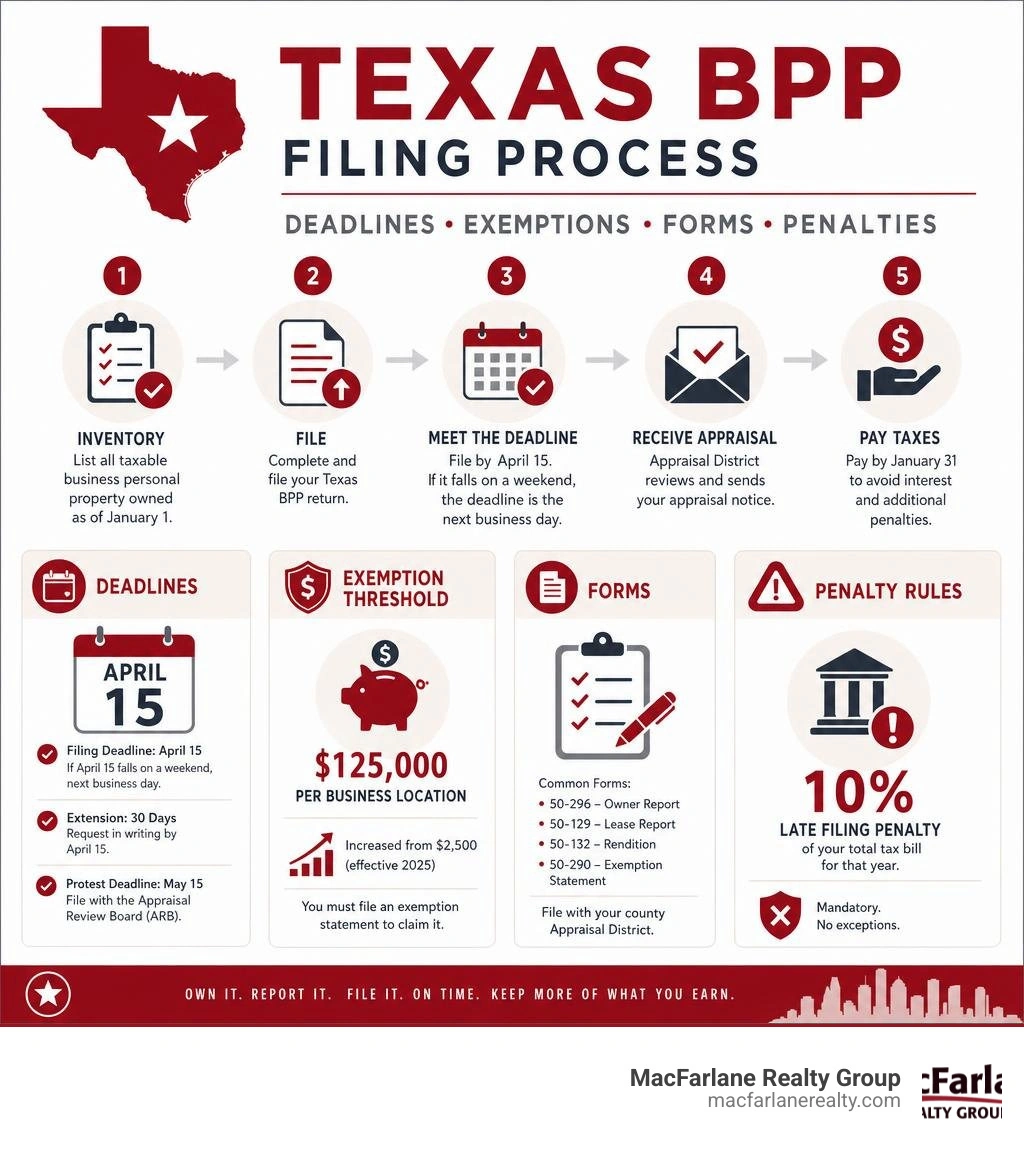
Here's what you need to know about Texas BPP filing — fast:
| Key Detail | What You Need to Know |
|---|---|
| What is BPP? | Tangible assets your business uses to generate income (equipment, furniture, inventory, computers) |
| Who must file? | Any business owning taxable personal property as of January 1 each year |
| Filing deadline | April 15 annually (next business day if it falls on a weekend) |
| Extension available? | Yes — 30 days, if requested in writing by April 15 |
| New exemption (2025) | $125,000 per business location, up from $2,500 |
| Must I still file if under $125,000? | Yes — you must file an exemption statement to claim it |
| Late filing penalty | 10% of your total tax bill for that year — mandatory, no exceptions |
| Protest deadline | May 15 with the Appraisal Review Board (ARB) |
If you own a business in Texas, you are taxed on more than just your building. Every piece of equipment, every desk, every computer your business uses to earn income — that is all taxable property. And every year, thousands of Texas business owners either miss the filing deadline, overlook the new $125,000 exemption, or accidentally overreport their assets and pay more than they owe.
The stakes got significantly higher in 2025, when Texas voters approved Proposition 9 and expanded the BPP exemption from $2,500 to $125,000 per location — a fifty-fold increase. That is real money on the table. But you only get it if you file correctly and on time.
I'm Michael J. MacFarlane, a real estate broker with over 30 years of experience helping Houston-area business owners navigate property decisions — including the often-overlooked world of business personal property taxes. This Texas BPP filing guide walks you through everything step by step, so you stay compliant, avoid penalties, and keep more of what you've earned.
Texas BPP filing guide word list:
To understand how to file your taxes, we must first look at what counts as Business Personal Property (BPP). In Texas, property is split into two main groups. The first group is real property, which is land and buildings. The second group is personal property, which is everything else.
If you own a business, any physical item you use to run that business and make money is considered Business Personal Property. The law says that these items are taxable. Every year, you must tell your local county appraisal district what items you own and what they are worth.
Your tax bill is based on what assets you own on one specific day: January 1st. Even if you sell an item or close your shop later in the year, you still owe taxes for the whole year if you owned those items on January 1st.
To keep your business compliant and avoid paying too much, you must report these items accurately. You can read more about this in our detailed guide on Business Personal Property Texas.

Not every asset in your office is taxed the same way. Texas only taxes tangible personal property. Tangible means things you can physically touch.
Here are common examples of taxable tangible assets:
On the other hand, intangible assets are exempt. This means you do not have to pay property taxes on them. Intangible assets include:
Sometimes the line between these two can get blurry. For example, a computer is taxable, but the custom software running on it is not. Knowing the difference can save your business thousands of dollars. For official county rules, you can check out the Harris County Appraisal District BPP Page.
As we mentioned, Texas business owners received a massive tax break. Thanks to Proposition 9, the BPP tax exemption jumped from a tiny $2,500 to a massive $125,000 per location. This change means that many small businesses will not owe any BPP tax at all!
However, there is a catch. The exemption does not apply automatically. You still have to let the county know that you qualify.
Here is a simple look at the difference between filing a full rendition and filing an exemption statement:
| Feature | Full BPP Rendition | Exemption Statement |
|---|---|---|
| Who files? | Businesses with over $125,000 in assets at a location | Businesses with $125,000 or less in assets at a location |
| What is required? | A detailed list of all assets, costs, and purchase years | A simplified statement declaring the property is under the limit |
| Valuation needed? | Yes, detailed good faith estimates or depreciated values | Yes, but only a simple declaration of total value |
| How often? | Every year by April 15th | Every year (to keep the exemption active) |
To claim this life-saving tax exemption, you must fill out the correct paperwork. The main form used across Texas is Form 50-144.
When you fill out this form, you will need to provide a "good faith estimate" of what your assets are worth. This does not mean you have to guess. It means you should look at what you paid for your equipment and apply a fair depreciation rate.
Even if your total business assets are worth only $10,000, you must file this form in the initial year to claim your exemption. If you do not file, the county will assume you have more than $125,000 in assets. They will send you a large tax bill, plus a late fee! You can download the necessary paperwork and find step-by-step help on our Texas BPP Rendition Form page.
Here is a secret that many business owners miss: the $125,000 exemption applies per physical location, not per business entity. This opens up amazing planning opportunities for businesses with multiple offices or shops.
Let's say you own a local retail brand with three small shops in Harris County, Fort Bend County, and Montgomery County. If each shop has $80,000 worth of shelves, registers, and inventory, your total business assets are $240,000.
To make this work, you must keep excellent records. Do not mix your asset lists. Keep a separate inventory list for each physical address. If you move a delivery van or a printer from one office to another, update your logs immediately. For more tips on managing your filings in the Houston area, read our Harris County BPP Help Guide 2026.
In property taxes, timing is everything. Missing a single date can cost your business a lot of money.
The most important date on your calendar is April 15th. This is the official deadline to submit your BPP rendition or exemption statement to your county appraisal district. If April 15th falls on a Saturday or Sunday, the deadline moves to the very next business day.
If you need more time to gather your invoices and count your inventory, do not panic. You can get a 30-day extension. But you must ask for this extension in writing (or online through your county's portal) on or before April 15th. This moves your deadline to May 15th. To stay on top of these dates, check out our guide on the Property Tax Rendition Deadline.
When you file your BPP rendition, you will use Texas Comptroller Form 50-144. Depending on how much your assets are worth, you will need to fill out different schedules attached to the form:
Filling out these schedules correctly ensures that the county applies the right depreciation rates. This keeps your tax bill as low as possible. You can find more details on how to fill out these schedules in our article on BPP Renditions.
If you do not file your BPP rendition by April 15th (or May 15th with an extension), the consequences are severe:
To avoid these costly headaches, read our comprehensive Business Personal Property Tax Guide.
What happens if you file your BPP rendition, but the county sends you a notice saying your assets are worth far more than they actually are? This happens all the time. The county might use outdated depreciation tables, or they might think you still own old equipment that you threw away years ago.
Fortunately, you have the right to protest. You can take your case to the local Appraisal Review Board (ARB). The official deadline to file a protest is usually May 15th (or 30 days after you receive your value notice).
Protesting is your chance to correct the record and lower your tax bill. Many times, you can resolve the issue quickly just by calling your local appraisal district office and showing them your paperwork.
If you need to file a formal protest, follow these three steps:
Yes. If you run a business out of your home in Harris, Fort Bend, or any surrounding county, you are still legally required to file a BPP rendition. If you use a computer, a desk, a printer, or specialized tools to make an income, those assets are taxable.
However, because most home-based businesses have less than $125,000 in total assets, you will likely qualify for the full tax exemption. You still need to file Form 50-144 to claim it and stay compliant.
Yes, but who pays the tax depends on your lease agreement.
Under Section 4 of the rendition form, you must list any equipment you lease, control, or manage but do not own. This includes things like leased office copiers, ice machines, or delivery vans. In many cases, the leasing company (the lessor) will file the rendition and pay the tax, then bill you for it. Always check your lease contract to see who is responsible for the property taxes.
In very limited cases, yes. If you made a major mistake on your filing, you can ask the appraisal district to let you file an amended rendition.
However, this is entirely up to the discretion of the chief appraiser. It is much easier and safer to get your numbers right the first time rather than trying to fix an error after the April 15th deadline has passed.
Navigating Texas Business Personal Property taxes can feel overwhelming. Between tracking your assets, calculating depreciation, and meeting strict deadlines, it takes a lot of time away from running your actual business.
At MacFarlane Realty Group, we believe in providing concierge-level service, clarity, and care for all of life's transitions. With over 25 years of local expertise in Houston and surrounding counties, we are here to make your property tax compliance stress-free. Whether you need help organizing your multi-location assets or protesting an unfair county valuation, we have you covered.
Don't let the April 15th deadline sneak up on you. Let's handle your property tax needs with quiet confidence and real-world savvy. For personalized assistance, visit our Professional BPP Tax Help page, or Get expert property tax services today. Tell us what you need. We'll handle the rest.

Ask a question, request a home valuation, or get an honest read on the current market. We are here when you are ready.