July 2, 2026

Protesting Your Texas Property Taxes Like a Pro

Master the property tax protest process Texas with our step-by-step guide to filing, deadlines, evidence, and appeals for lower 2026 taxes.

Your Property Tax Bill Feels Wrong — Here's What to Do About It

The property tax protest process in Texas lets every property owner fight the value the county puts on their home. This can help lower your tax bill.

Here is the quick way it works:

  1. Get your Notice of Appraised Value (this usually comes in the mail by May 1)
  2. File a Notice of Protest (Form 50-132) by May 15, or within 30 days of getting your notice
  3. Ask for a quick meeting with the county to try to agree on a lower value
  4. Go to your Appraisal Review Board (ARB) hearing if you cannot agree
  5. Get the board's final decision in writing — then decide if you want to accept it or fight it more

That is the main idea. The sections below explain each step in an easy way.

Every spring, homeowners in Texas get a letter showing how much the county thinks their home is worth. Many people are surprised because the value went up a lot. This number is important because it decides how much tax you must pay.

The good news is that you do not have to just accept it.

Texas has great laws that protect taxpayers. Fighting your value is your legal right. It costs nothing to start, and most people settle their cases quickly without ever going to court.

My name is Michael J. MacFarlane. I am a real estate broker with over 30 years of experience helping people in the Houston area. I know the property tax protest process in Texas very well. In this guide, I will show you exactly what to do.
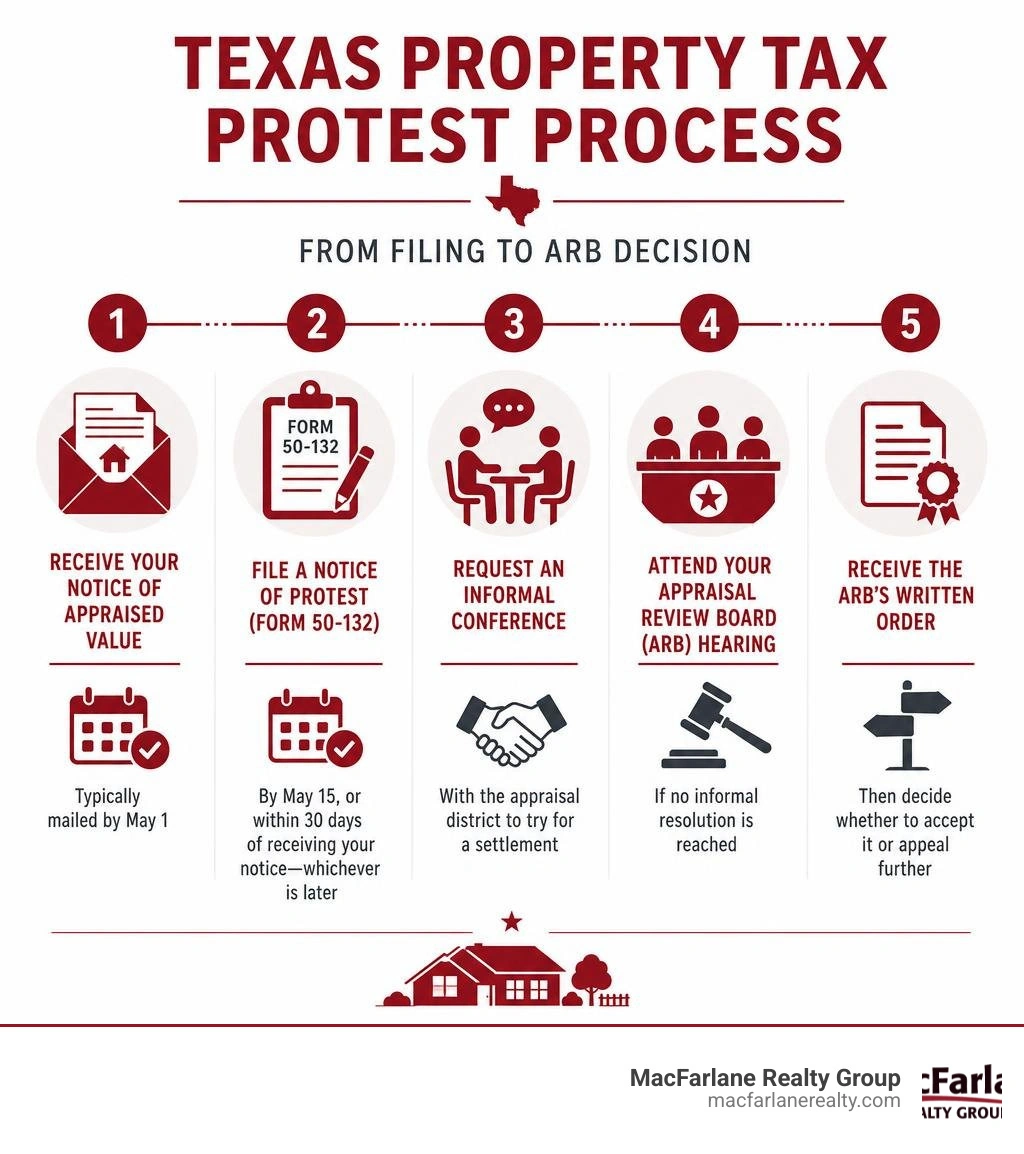
Texas property tax protest process timeline infographic from filing to ARB decision infographic

Easy terms to know:

Understanding the Property Tax Protest Process in Texas

The property tax system in Texas is based on a simple rule: your taxes should match what your property is actually worth. If the county gets that value wrong, you have the right to speak up.

When you start Filing a Property Tax Protest, you are using your rights as a taxpayer. You can read more about these rights on the Texas Comptroller's page for Appraisal Protests and Appeals.

Most people protest for two main reasons:

  • Over Market Value: The county says your home is worth more than what someone would actually pay to buy it on January 1.
  • Unequal Appraisal: Your home is valued higher than other similar homes in your neighborhood.

To see how your local tax rates affect your bill, look at our Property Tax Rates Houston Guide 2026. You can also use our Real Property Tax Calculator to get a quick look at your Property Tax Estimates.

Who Can File a Protest?

Who is allowed to protest?

Key Deadlines for the Property Tax Protest Process in Texas

Dates are very important. If you miss the deadline, you cannot protest.

  • May 15: This is the last day for most owners to file a protest.
  • 30 Days After Notice: If the county mails your letter after April 15, you have 30 days from the mail date to file.
  • Late Protests: The board might let you protest late if you have a very good reason, like being in the hospital. But this is hard to do. You must file before the board approves the final records, which usually happens by July 20.

For dates in your county, see our guide on the Montgomery County Property Tax Protest Deadline. You can also look back at the Harris County Property Tax Protest Deadline 2025 to see how the dates compare.

How to File Your Protest by County

Texas has 254 counties. Each county has its own tax office. The state laws are the same everywhere, but the way you file can be different.

Here is how to file in our local counties:

Online Portals and Electronic Delivery Options

Most big counties let you file easily online.

To sign up, you will need the Owner ID and PIN number printed on your notice letter. Once you log in, you can upload your proof, see the county's proof, and get settlement offers.

In counties with more than 120,000 people, you can ask to get all your letters and decisions by email. This is a great idea so you do not lose important mail. If you want to use paper forms, you can download the official PROPERTY APPRAISAL NOTICE OF PROTEST TAX YEAR 2026 or the Property Owner’s Notice of Protest.

Gathering Compelling Evidence for Your Case

organized folder with property tax protest evidence

You cannot win a protest by just saying, "My taxes are too high!" The board only looks at facts, numbers, and real proof.

Here is what you should collect to win your case:

Documenting Property Damage and Condition Issues

The county assumes your home is in good shape. If your home has problems, you must show them:

  • Foundation Cracks: Take clear pictures of cracks inside and outside. Get a written price quote from a repair company.
  • Roof Damage: Show pictures of leaks, missing shingles, or an old roof.
  • Interior Damage: Take pictures of old kitchens, water damage, or broken heaters.
  • Repair Estimates: Written quotes from workers are great proof. If it costs $20,000 to fix your roof, that cost should lower your home's value.

Selecting and Adjusting Comparable Sales

If you want to show your home is worth less, look at recent sales of similar homes nearby:

  • Find Similar Homes: Look for homes that sold close to January 1. They should be about the same size, age, and in the same area.
  • Compare the Features: If a neighbor's sold home has an extra bathroom or a pool, you must subtract that value to match your home.

To learn more about gathering proof, read our Property Tax Reduction Harris Guide 2026 and check out our Katy Property Tax Protest Guide.

After you file, the county will set up your meetings. The process has two main steps:

  • Informal Meeting:
    • Who is there: You (or your agent) and one county worker.
    • How it feels: Friendly, casual, and one-on-one.
    • Time limit: Usually 10 to 15 minutes.
    • Decision: You may get a quick offer to lower the value if you agree.
  • Formal Board Hearing:
    • Who is there: You, a county worker, and a 3-member board.
    • How it feels: Formal and structured, like a small court.
    • Time limit: Strictly limited, usually 15 minutes total.
    • Decision: The board votes and decides at the end.

Most protests are settled during the first informal meeting. The worker will look at your photos and repair quotes. They will often offer to lower your value right then. If you agree, you sign a paper and you are done.

If you do not agree, you go to the formal hearing. The Appraisal Review Board (ARB) is a group of local citizens. They do not work for the tax office. To learn about your rights, read the Taxpayer Assistance Pamphlet.

Special Panels and Single-Member Panels

If you own a very expensive business property, you have other choices:

  • Special Panels: In big counties, special groups of experts hear cases for very large properties. In 2026, the property must be worth at least $62,883,169 to qualify.
  • One-Member Panels: You can ask for just one board member to hear your case instead of three. You must ask for this in writing on your protest form.

Presenting Your Case at the Hearing

If you go to the formal hearing, be ready:

  • 15-Day Notice: The board must tell you the date and time at least 15 days before the hearing.
  • Share Your Proof: You must show your pictures and papers to the county worker before the hearing starts.
  • Who Must Prove It: The county must prove that their value is correct. You do not have to prove them wrong first.
  • Use Facts, Not Feelings: Be polite. Do not complain about high taxes. Just talk about the facts, like damage to your home or lower sales prices nearby.

Beyond the ARB: Appealing the Final Decision

steps of a Texas courthouse where property tax appeals are filed

If you do not like the board's final decision, you can keep fighting. Once you get their decision in writing, you can file a Property Tax Appeal.

You can read about the full Property Tax Appeal Process and find out about Property Tax Appeal Representation if you want a professional to help you.

Your Choices for Appealing

  • District Court: You can take your case to a local court. You must file this within 60 days of getting the board's decision.
  • State Office of Administrative Hearings (SOAH): For properties worth over $1 million, you can ask a state judge to decide. You must file this within 30 days and pay a deposit.
  • Binding Arbitration: This is a cheaper and faster way to appeal without a lawsuit. It is available for any home you live in, or other properties worth $5 million or less. An independent person will make the final choice.

If you are new to this, read our guide on How to File a Property Tax Appeal.

Common Mistakes and Procedural Rights

To make sure you win, avoid these common mistakes:

  • Complaining About Tax Rates: The tax office does not set the tax rates. They only decide what your home is worth. Only talk about your home's value and condition.
  • Missing Deadlines: If you miss the May 15 deadline, you will likely lose your right to fight.
  • Not Asking for the County's Proof: Always ask to see the county's evidence packet before your hearing. You have a legal right to see what information they are using.
  • Not Paying Your Taxes: If you are still fighting your bill when taxes are due, you must still pay the amount you agree with on time. If you do not, you lose your right to appeal.

If the county forgets to send you an important letter, you have rights. You can file a late protest because you did not get the notice. If they break the rules, you can also ask for help to force them to follow the law.

Frequently Asked Questions About Texas Property Tax Protests

What happens if I miss the May 15 protest deadline?

If you miss the date, you might still get a hearing if you have a very good excuse. You can also file a form to fix a big mistake on your bill. But you must do this before the final records are approved, which usually happens by July 20.

Can I protest my property taxes online in every Texas county?

No. Texas law says big counties with over 500,000 people must let you protest online. Many smaller counties have online systems too, but some small towns still require you to mail in paper forms.

Do I have to pay my property taxes while my appeal is going on?

Yes. To keep your right to appeal, you must pay the amount of taxes you do not dispute before the January 31 deadline.

Let Us Handle the Stress for You

Fighting your property taxes in Texas can feel like a lot of work. It takes a lot of time to find home sales, take pictures of damage, and talk to the board.

At MacFarlane Realty Group, we have over 25 years of experience helping people with their properties. We make the process easy and stress-free. Whether you need help with Business Personal Property Texas taxes, BPP Renditions forms, or protesting your home's value, we are here for you.

Let us help you with your next step. Visit our MacFarlane Realty Group Tax Services page, tell us what you need, and we will take care of the rest.

Lates Articles

You’re Not
Just a Transaction

We’ve built our firm on relationships, not online leads. Most of our clients come through referrals, and many come back for future moves—sometimes across multiple generations. That kind of trust comes from showing up, doing the work, and never cutting corners.

What Our Clients Say

Excellent guidance on our commercial purchase. The team was knowledgeable, responsive, and made every step straightforward.

Sam Scott, Houston

Let’s Get Started

Whether you're buying your dream home or preparing to sell, MacFarlane Realty Group is ready to guide you with professionalism and care.

MacFarlane Realty Group Serving Houston’s residential & commercial real estate needs with clarity, care, and over 25 years of trusted experience.

© 2025 Macfarlane Realty. All Rights Reserved