July 3, 2026
Use our real estate income tax calculator to estimate rental income, depreciation, and after-tax cash flow for Houston properties.
A real estate income tax calculator is a tool. It helps you see how much money you will keep from renting out a house after you pay for bills, wear and tear, and taxes. Here is what it shows you:
| What It Is | What It Means |
|---|---|
| Net Operating Income (NOI) | The money you make from rent minus regular bills, before paying loans or taxes |
| Cash-on-Cash Return | How much cash you get back compared to the cash you put in |
| Taxable Income | The amount of money the government actually taxes you on |
| After-Tax Cash Flow | The real cash left in your pocket when everything is paid |
| Cap Rate | How good the deal is, without looking at how you borrowed money |
These numbers help you see if a rental house is a good deal.
Many people only look at the total rent money. That is a mistake. The government taxes rent money just like job pay. If you make $5,000 in profit and your tax rate is 22%, you must pay $1,100 to the government. You also have to pay for repairs, insurance, and house taxes. This means you keep much less than the total rent.
That is why you should use a calculator before you buy a house.
I am Michael J. MacFarlane. I have been a real estate broker in Houston for over 30 years. I help people buy rental homes and understand the real costs. A real estate income tax calculator shows you the real money you get to keep. Below, I will explain how it works in simple steps.
Quick links to help you:
When you buy a rental house, you want to know how much money you will really make. Many people just look at their bank account at the end of the month. But that does not show what you will owe the government in taxes.
To find your true profit, you must know two different things: taxable income and after-tax cash flow.
Taxable income is the money the government can tax. After-tax cash flow is the actual cash left in your pocket after you pay all bills, house loans, and taxes. These two numbers are usually different. A house can put cash in your pocket but look like it lost money on paper. Or, it can look like it made money on paper but leave you with no cash.
Using a Rental Property Returns and Income Tax Calculator helps you see these numbers clearly. It stops you from guessing. If you want to see how local house taxes affect your money, you can also use our Real Property Tax Calculator for the Houston area.
A calculator only works well if you give it the right facts. Here is what you need to know:
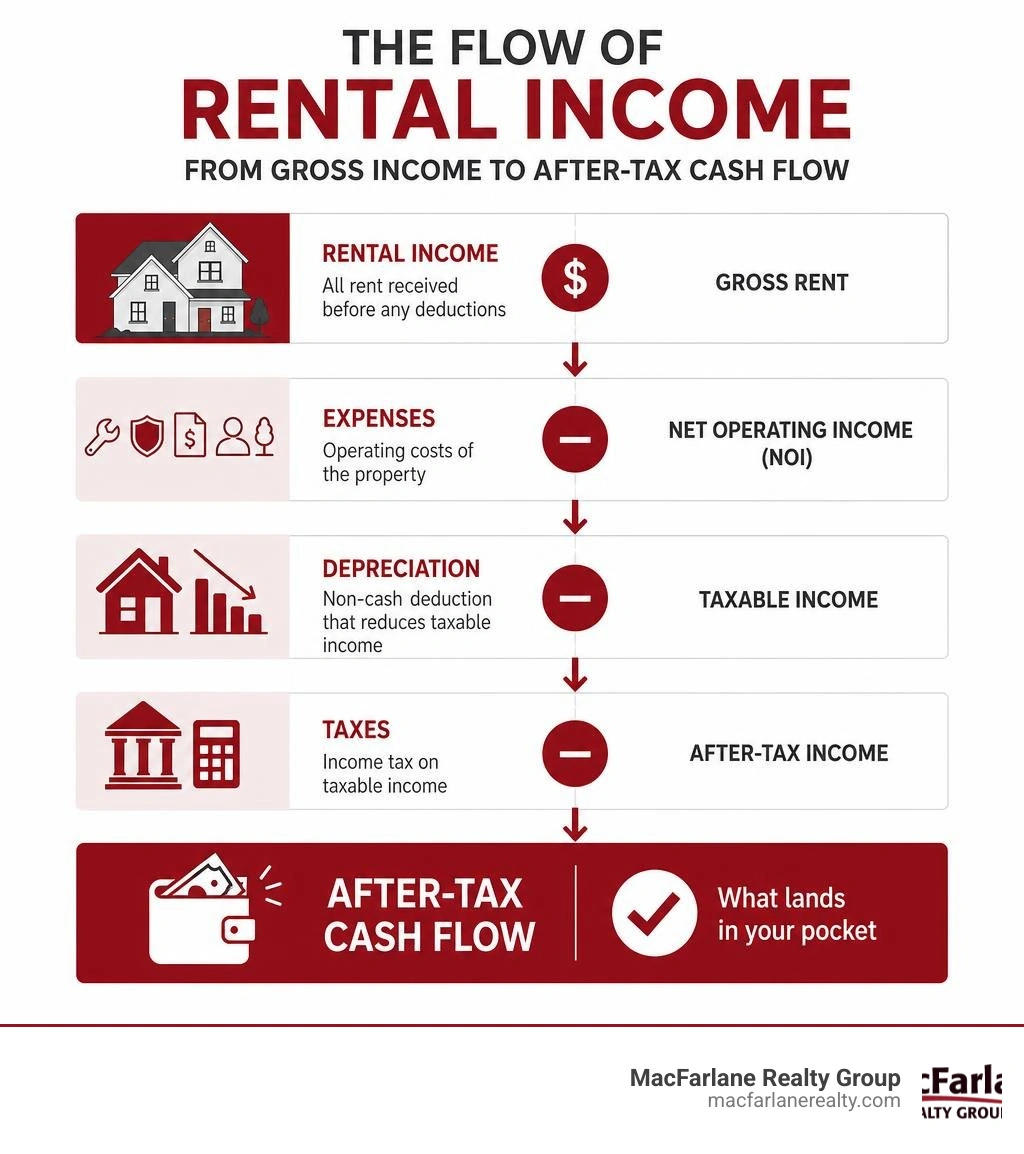
Let's look at how a real estate income tax calculator uses these facts to find your basic profit. We start with your total rent and subtract costs to find your Net Operating Income (NOI).
First, we find your Annual Gross Rent. This is your monthly rent times 12. If rent is $2,500 a month, your yearly rent is $30,000.
Next, we subtract Vacancy. If the house is empty 5% of the time, we subtract $1,500. This leaves you with a Net Rent of $28,500.
Now, we add up all your regular bills. This includes taxes, insurance, repairs, and management fees. Do not include your house loan payment here.
Next, subtract these bills from your Net Rent. The money left is your Net Operating Income (NOI).
$$\text{NOI} = \text{Net Rent} - \text{Total Expenses}$$
Your NOI is very important. It shows how good the house is at making money on its own.
With your NOI, you can find the Cap Rate. You find this by dividing your NOI by the price of the house.
$$\text{Cap Rate} = \frac{\text{NOI}}{\text{Purchase Price}} \times 100$$
This percentage helps you compare different houses quickly. Texas does not have a state income tax, so house taxes are a big part of your bills. To learn more about how Texas taxes work, read our guide on Texas Property Tax.
When you are looking at houses in Katy, Spring Branch, or The Woodlands, you might not have time for a full math check. You can use two quick rules instead:
The 1% Rule says the monthly rent should be at least 1% of the house price. For example, a $250,000 house should rent for $2,500 a month. This is hard to find today, but it is a good goal.
The 50% Rule helps you guess your bills. It assumes that half of your rent money will go to bills (not counting the loan). If rent is $30,000 a year, you will likely spend $15,000 on bills.
These rules are just for quick guesses. You should always use a real calculator before buying. If you want to find an Investment Property Houston buyers can trust, we can help you run the real numbers.
If you get a loan to buy your rental house, your loan details will change your cash flow. A good real estate income tax calculator must include your loan payments.
Your monthly loan payment has two parts: Interest and Principal.
For taxes, these two parts are very different. Interest is a cost you can subtract to lower your taxes. Principal is the money that pays down the loan. You cannot subtract principal to lower your taxes. Even though it builds your ownership, the government still taxes it as profit.
Your Net Cash Flow is the real cash left over after you pay all bills and your full loan payment.
$$\text{Net Cash Flow} = \text{NOI} - \text{Annual Debt Service}$$
To see how hard your money is working, we find your Cash-on-Cash Return. This is your yearly cash flow divided by the cash you paid to buy the house.
$$\text{Cash-on-Cash Return} = \frac{\text{Net Cash Flow}}{\text{Total Cash Invested}} \times 100$$
Banks will also look at your Debt Service Coverage Ratio (DSCR). This compares your NOI to your loan payment.
$$\text{DSCR} = \frac{\text{NOI}}{\text{Annual Debt Service}}$$
A score of 1.2 or more means the house makes 20% more money than the loan payment. Banks like to see this. To find these numbers for your houses, you can use the Rental Property After-Tax Cash Flow Calculator(2026) | The Money Pocket.
Now we get to the best part of rental houses: taxes. This is where we find your Taxable Income, Income Taxes, and your final After-Tax Cash Flow.
Rental houses have special tax rules. You can use smart Tax Savings Strategies to lower your taxes and keep more cash.
Here is an example of how a house can make real cash but look like it lost money on paper:
| Item | Cash Flow View | Tax Return View |
|---|---|---|
| Rent Income | $30,000 | $30,000 |
| Bills | -$12,000 | -$12,000 |
| Loan Interest | -$10,000 | -$10,000 |
| Loan Principal | -$2,000 | $0 (Cannot subtract) |
| Wear and Tear (Depreciation) | $0 (Not real cash) | -$9,000 |
| Total | +$6,000 (Real Cash) | -$1,000 (Paper Loss) |
In this example, you put $6,000 of real cash in your pocket. But you owe $0 in taxes because the paper says you lost $1,000! This is how rental taxes work.
Depreciation is like a tax shield. The government lets you subtract the cost of the building over 27.5 years because buildings get old.
Here is how you find your yearly tax break:
Every year for 27.5 years, you subtract $10,000 from your taxable income. You do not actually pay this money to anyone, but it saves you a lot on taxes.
To see how this works for your tax bracket, use the IRS Rental Income Tax Calculator 2025 & 2026 — 27.5yr Depreciation & PAL Rules. For a full plan on how to save, read our Best Tax Savings Strategies Guide.
While a real estate income tax calculator is a great tool, it cannot do everything. Tax laws are very tricky. Here are some important rules to know:
Because of these hard rules, a calculator is only for guessing. You should always talk to a tax professional. If you want to build your wealth, look at options for a Houston Investment Property that fits your goals.
Yes. The government taxes your net rental profit just like the money you make at a job. If you are in the 24% tax bracket, your rental profit is taxed at 24%. But remember, you only pay tax on the profit left after you subtract all bills and wear-and-tear tax breaks.
When you sell a rental house, the government wants to take back some of the tax breaks you got for wear and tear. This is called depreciation recapture. It is taxed at a rate of up to 25%. Many people use a special rule called a 1031 exchange to avoid paying this tax right away when they sell.
Usually, no. The government calls rental income "passive." This means rental losses can only offset rental profits. But there are two exceptions:
Understanding rental taxes does not have to be scary. When you know how a real estate income tax calculator works, you can make better choices and keep more of your money.
At MacFarlane Realty Group, we have over 25 years of experience helping people buy and sell homes. Whether you want a home in Memorial, a business building in Houston, or help fighting your property taxes in Harris, Fort Bend, or Montgomery counties, we are here to help you.
Ready to start?

Ask a question, request a home valuation, or get an honest read on the current market. We are here when you are ready.