June 3, 2026
Master BPP renditions with this A-Z guide covering deadlines, exemptions, and filing requirements under Texas law.
BPP renditions are yearly reports that Texas business owners must send to their local tax office. These reports list the items your business uses to make money.
Here is the quick version:
Many business owners do not know they have to file this form. They only find out when they get a penalty fee on their tax bill. The rules about rented equipment and extensions can also seem tricky.
This guide will explain everything in a simple way.
My name is Michael J. MacFarlane. I am a real estate broker with over 30 years of experience. I help business owners in the Houston area handle their property taxes and business rules. Whether this is your first time filing or you want to avoid mistakes, this guide will help you.
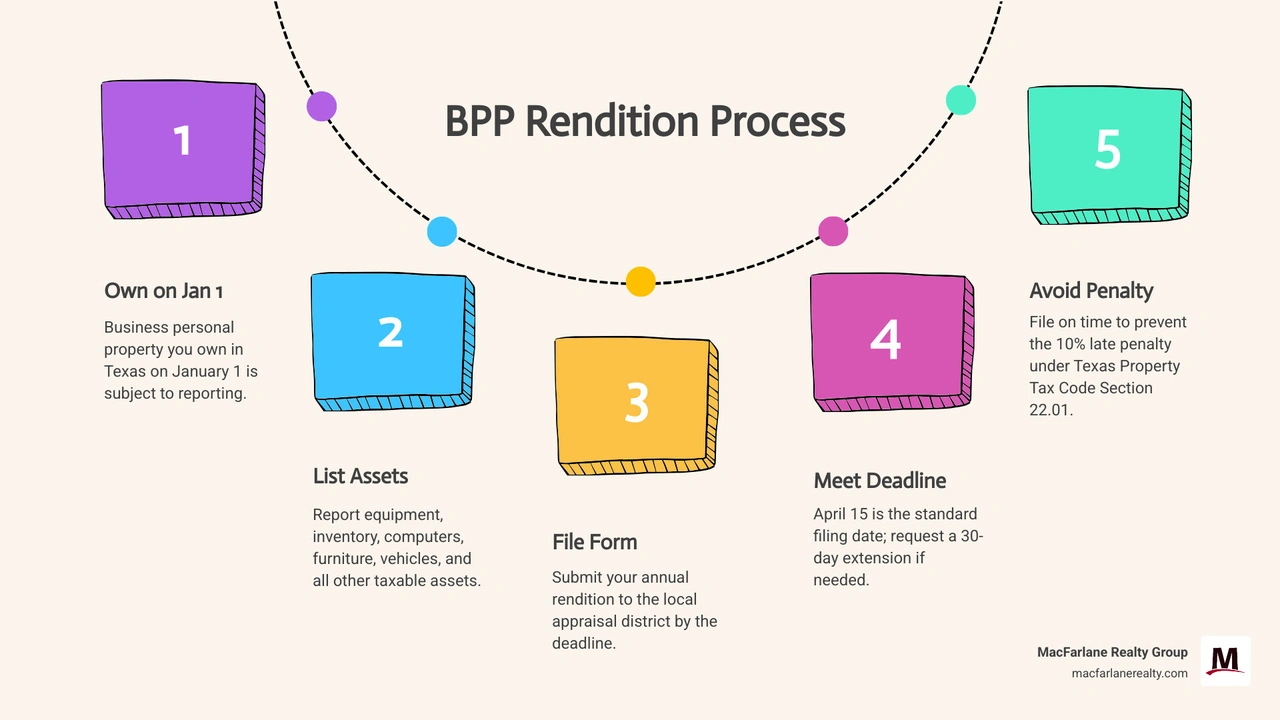

Before we look at the forms, let us talk about what is being taxed.
In Texas, property taxes are not just for land and buildings. They are also for the items inside your business that help you make money. This is called Business Personal Property (BPP).
The law says BPP is any physical item you use to run your business. If you can touch it, move it, and use it to make money, it is likely BPP.
Common examples of BPP include:
Here is an easy way to see the difference between real property and BPP:
To learn more about these rules, you can read our guide on Business Personal Property Texas.

A BPP rendition is not a bill. It is just an information report. You send this report to your local county tax office. This office is called the appraisal district.
This form tells the county what items you own, where they are, when you bought them, and what they cost. The county uses this list to figure out how much your items are worth. Then, they use that value to calculate your tax bill.
Texas law says you must file this form. If you own or manage items used to make money, you have to report them.
For local rules on how to handle these forms, you can read the HCAD Guide to Personal Property Renditions.
Why do you have to do this every year?
It is because your business items change. You buy new computers, sell old trucks, and your inventory goes up and down.
Your taxes are based on what you own on January 1st of each year. Even if you close your business later in the year, you still owe taxes based on what you had on January 1st.
Filing your form every year keeps the county's records correct. If you do not file, the county will guess what your business is worth. Their guess is usually much higher than the real value. They might even tax you for "ghost assets"—which are items you threw away or sold a long time ago.
To start your filing, you can download the standard Texas BPP Rendition Form.
Texas has a great tax break: a $125,000 BPP exemption for each location. This means if all your business items at one location are worth less than $125,000, you do not have to pay taxes on them.
But you still have to file the form the first year you ask for this tax break.
Many business owners make the mistake of ignoring the form because their items are worth very little. If you do not file the form the first year, the county cannot check your items. They will not give you the tax break, and you will get a tax bill and a penalty fee.
You can read more about how to fill out these forms on the FBCAD page for Completing Your BPP Rendition.
Timing is very important for property taxes. Put these dates on your calendar so you do not miss them:
If April 15 is on a weekend or a holiday, the due date moves to the next business day. To learn more about these dates, read our guide on the Property Tax Rendition Deadline.
If you need more time to list your items, you can ask for 30 extra days. This moves your due date from April 15 to May 15.
To get this extra time, you must send a written request. You can do this online through your county's website or by mailing a letter before April 15.
If your business is very large and complex, you can ask for 15 more days (moving the date to May 30). But you must have a very good reason for needing the extra time.
Filling out your form does not have to be hard. If you keep good records, you already have most of the information you need.
Here is what you should gather before you start:
When you fill out the form, you can write down what you paid for your items and when you bought them. The county will then use a chart to lower the value based on how old the items are. Or, you can write down what you honestly think the items are worth today.
For a step-by-step guide, check out our Business Personal Property Tax Guide.
If you rent copiers, lease big machines, or sell items for other people, you do not own them. But you still have to report them.
There is a special section on the form for rented items. You must list:
Reporting these items correctly helps the county tax the right person. It also keeps you from getting billed for things you do not own.
Filing your form on time is the easiest way to save money. If you miss the due date, you will have to pay extra fees.
You must pay these fees if you are late. Even if your business does not owe taxes, you will still get a penalty fee for filing late. You can read more about these rules on the Renditions (BPP) - Williamson CAD page.
Yes. If your business was open on January 1st, you must pay taxes for the whole year. Texas does not split the tax bill if you close your business in February or June. You must still file your form by April 15.
If you close your business after January 1st, tell the county tax office. This way, they can close your account for the next year.
Usually, no. If you are the business owner or a full-time worker filing the form, you do not need a notary.
Also, if your business items are worth less than $150,000, you do not need a notary. But if you hire an outside tax helper to file for you, and your items are worth more than $150,000, the form must be signed in front of a notary.
Texas offers other ways to lower your tax bill besides the $125,000 tax break:
To find more ways to save money, read our guide on Tax Savings Strategies.
Handling your business taxes does not have to be a headache. You can keep your tax bills low by keeping good records, filing your BPP renditions before April 15, and using the $125,000 tax break.
At MacFarlane Realty Group, we have spent over 25 years helping business owners in Houston, Katy, and The Woodlands. We help make business rules and property taxes easy for you.
Let us handle the paperwork so you can focus on growing your business. Get expert help with your property tax services today!

Ask a question, request a home valuation, or get an honest read on the current market. We are here when you are ready.