April 29, 2026
Navigate Business personal property tax confidently. Learn to calculate, file, claim exemptions, and avoid penalties for optimal savings.
Business personal property tax is a tax on the things your company owns and uses to work. This includes items like computers, machines, desks, and tools. It is different from real estate tax, which is only for land and buildings.
Quick Facts:
Many business owners pay too much money. They spend a lot of time on taxes but make mistakes. Some companies saved 20% just by fixing their reports.
Rules are different in every state. Some states do not have this tax at all. If you get it wrong, you might have to pay extra fees.
My name is Michael J. MacFarlane. I have helped many business owners with their property and taxes for over 30 years. I can help you understand these rules.
This tax is for the "stuff" your business owns. Think of it this way: if you could pick up your office and shake it, everything that falls out is personal property.
Real property is the land and the building. It stays in one place. Personal property is everything else that can be moved.
Most things you use to make money are on the list. This includes:
It is important to know the difference. Real property is the land. Personal property is the equipment.
Think about a big freezer in a kitchen. If it is part of the wall, it is real property. If you can unplug it and move it, it is personal property. This matters because they are taxed differently.
To find the value, start with the total price you paid. This is not just the price on the tag.
When you report your items, include:
Be very careful. Many businesses pay taxes on things they don't have anymore. These are called "ghost assets." If you sold or threw away an item, take it off your list!
Every year, walk through your office. If a printer is in the trash, make sure you stop paying taxes on it. You can find more info about tax protests on our site.
Items don't stay new forever. They wear out and become worth less money. This is called depreciation. The tax office uses a chart to see how much an item is worth based on how old it is. In Canada, this is called Capital Cost Allowance (CCA). Knowing these rules can save you thousands of dollars.
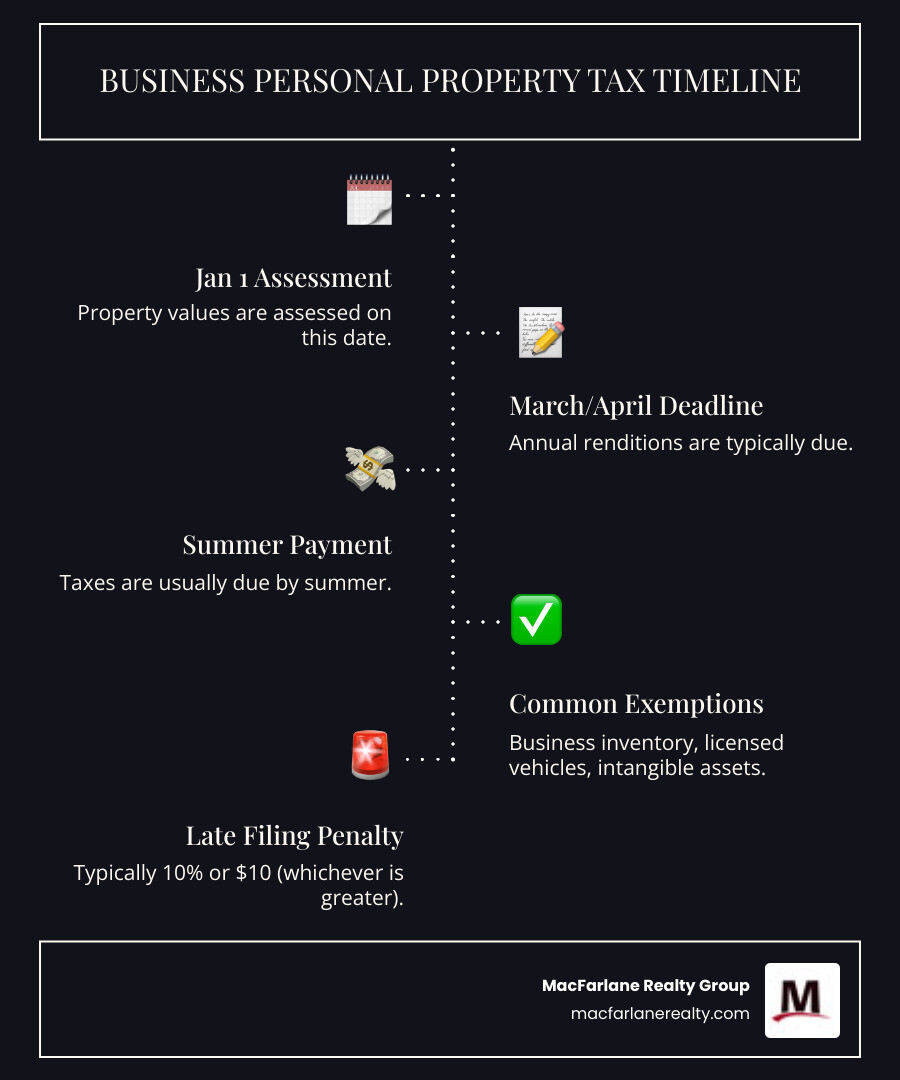
A "rendition" is just a report. You send it to the county to tell them what you own. In Texas, the most important date is January 1. Whatever you own on that day is what you pay taxes on for the whole year.
If you don't send the report, the county will guess what you own. Their guess is usually much higher than the truth.
You will also have to pay:
Many people make the same mistakes. One big mistake is paying too much. You don't have to pay taxes on things you can't touch, like warranties or training. If a machine cost $50,000 and the training cost $5,000, you only pay tax on the $50,000.
Tax breaks are like coupons. You have to ask for them to get them.
Did you bring your own laptop from home to use for work? That is moving an asset.
Tax laws change when you go to a different state or country.
In our area, the Harris County Appraisal District (HCAD) and other local offices make the rules.
In Canada, the rules are different. They look closely at how items lose value over time. In places like British Columbia, you also pay sales tax on equipment. If you drive a truck between provinces, you might pay taxes based on how far you drove in each place.
In many states, yes. But in Texas, items you sell (inventory) are usually tax-free. You still have to list them on your report, but you won't get a bill for them.
You will pay a 10% fine right away. The tax office will also guess what you own. You can try to change their guess later, but it is much harder than filing on time.
Yes. If you move a personal car to your business in Canada, you might get a tax credit for the GST based on what the car is worth today.
Taking care of your Business personal property tax does not have to be scary. You just need to be organized and have help. At MacFarlane Realty Group, we have helped people in Houston for 25 years. We help with office space and taxes to make your life easier.
Don't let the county guess and take your money. Take control of your reports and look for tax breaks. Always protect your property value by being ready. If you need help with Texas taxes, we are here. Call us today, and we will do the hard work for you.

Ask a question, request a home valuation, or get an honest read on the current market. We are here when you are ready.